Monday, May 19, 2014
Maninderjit: Select the best, and give your best..
COACH K. Dharmaraj will name his squad for the World Cup today, with minor changes from the Champions Challenge 1 squad which finished third in Kuantan.
The major boost could be in the form no 1 penalty corner flicker and defender Razie Rahim, if he is give the green light on his dislocated shoulder by the medical team.
And Razie’s right-hand man Baljit Singh is also hoping to be included after being rested for the Azlan Shah Cup and the Champions Challenge 1.
For the record, with the absence of these two stalwart defenders, Malaysia scored 17 goals, but also let in 17 goals in the Champions Challenge 1.
Former international Maninderjit Singh, who has played in two World Cups, two Olympics, two Asian Games, Champions Trophy and Commonwealth Games -- feels Dharmaraj should select the best without fear-or-favour.
“There were some rumblings on the ground during the Champions Challenge 1 that the best were not selected and that demoralised some players. Coach Dharmaraj had to come out strongly in the media to calm matters.
“The coach should select the best, as in the end, he will be the one answerable on the team’s performance at the World Cup,” said Maninderjit who played in the 1998 Utrecth and 2002 Kuala Lumpur World Cups.
His Olympic moments were in 1996 Atlanta and 2000 Sydney.
Another player who could make a comeback to the fold is Shahrun Nabil, a former skipper, who was dropped from Champions Challenge 1 because he sent a nasty sms to one of the coaches.
Shahrun’s absence also made a big difference as he is a dependable midfielder.
Dharmaraj had said that there will be minor changes, as he fights for time to name the team: “There could be some changes from the Kuantan squad, but only two or three as time is not with me.”
Malaysia last played in the World Cup back in 2002, and their opening opponents were Australia, who will again be the main opening hurdle for Dharmaraj’s men on May 31.
Australia, world no 1, and world No 13 Malaysia last played in the Azlan Shah Cup final and the score was an unflattering 8-3.
“When we played Australia in the opening match in 2002, the score was 0-0 at half-time. But we let in three soft goals in the second half. My team was at the verge of playing in the semi-finals but lost out the spot to South Korea when we drew 2-2 with Poland.
“My advise to the players who will be heading to the Hague is that to become better players, they must not fear when playing the best in the world. I actually enjoyed playing against opponents like Australia, Germany and Nether lands.
“We were told by our coaches then that ‘Will beats Skills’ and that motivated us to finish 8th among 16 teams in Kuala Lumpur which i believe is a big achievement. I hope the current batch will not give up until the final whistle as every team in the world is beatable just with sheer determination and will-power,” said Maninderjit.
The Malaysian Hockey Confederation (MHC) believe their charges should at least finish 10th among the 12 teams in the Netherlands, but in reality, they will be struggling not to sink to the bottom like a rock.
Sunday, May 18, 2014
Rajan sets Pahang semis target...
FORMER national juniors hockey coach K. Rajan will be coaching the Pahang Malaysia Games team in Perlis, and he has set a semi-finals target for his boys.
The Games will be held from May 24-June 4, with 13 teams in the boys as well as 13 teams in the girls hockey tournament.
Pahang are in Group A with defending champions Terengganu, Johor, Perlis, Perak and Sabah.
In Group B are 2012 runners-up Kuala Lumpur, Selangor, Penang, Malacca, Negri Sembilan, Sarawak and Kelantan.
The top two teams from each group to play in the semi-finals.
The women’s event will also have 13 teams with champions Terengganu in Group A with Johor, Sarawak, Negri Sembilan, Pahang and Sabah.
The teams in Group B are KL, Selangor, Perlis, Perak, Penang, Malacca and Kedah.
“The target is to qualify for the semi-finals, and in the long run, we plan to become champions by 2016 as 15 from the current 18 are still eligible to play in two years time,” said Rajan.
Selangor, who have never won the Malaysia Games gold, are keen to finally lay their hands on it.
Selangor ended their 21-year wait for the National Under-21 title when they beat Perak in last year’s final. The regulation time score was 3-3 but Selangor won the penalty shoot-out 5-4 -- despite not having an artificial pitch to train on.
“We are confident of doing well in the Malaysia Games as we have been preparing the team since 2012,” said Selangor HA secretary P. Kuganeson.
Saturday, May 17, 2014
Sikhs at Kuala Lumpur World Cup 2002
by Dil Bahra

Malaysia’s umpire, Amarjit Singh, in action during the Kuala Lumpur 2002 World Cup.
In our series of the impact Sikhs have had at Men’s Hockey World Cups, we look at the tenth World Cup held in Kuala Lumpur, Malaysia 2002.
The tenth Men’s Hockey World Cup was held at Malaysia National Hockey Stadium, Bukit Jalil, Kuala Lumpur, Malaysia from 24 February - 9 March 2002.
Sixteen nations competed and were divided into two pools of eight as follows:
Pool A: Argentina, Belgium, Germany, Netherlands, New Zealand, Pakistan, South Africa and Spain.
Pool B: Australia, Cuba, England, India, Japan, Korea, Malaysia and Poland.
One Sikh Official, an umpire, was appointed for the Kuala Lumpur World Cup.
Amarjit Singh of Malaysia was on the Umpires panel for his second World Cup, having umpired at the Utrecht 1998 World Cup. He was born in Ipoh, Malaysia and was educated at the Anglo-Chinese School in Ipoh. He graduated from the Open University Malaysia. He was associated with the Perak State Players Association.
He started umpiring at the age of 20 and his first international match was in a 4 Nations tournament in Darwin, Australia when he umpired the Australia v Argentina match in May 1992. He was awarded his International badge in April 1993 and his Grade 1 badge in February 1996. He umpired at the Commonwealth Games in Kuala Lumpur, Malaysia in 1998 and was awarded his World Panel badge in August 1998.
He umpired at the Sydney 2000 Olympic Games.
The Indian team, which was captained by a Sikh, Baljit Singh Dhillon, had seven Sikhs in their squad for Kuala Lumpur 2002 World Cup. This was the exact same setup as in 1975 when the World Cup was played in Kuala Lumpur in 1975 and India won the Gold.
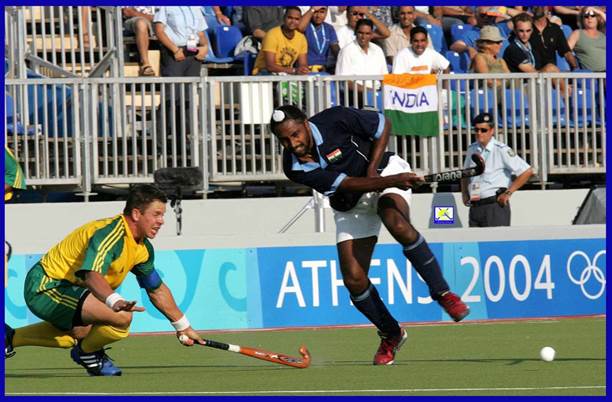
Baljit Singh Dhillon in action
Baljit Singh Dhillon, India’s captain at the Kuala Lumpur 2002 World Cup, was born in Padhr, near Amritsar. He studied at Khalsa College Jalandhar. A forward, he played for Punjab Police and earned his first international cap in 1993 against South Africa. He played at the Champions Trophy in 1995 in Berlin and the Asian Games in 1994 in Hiroshima and in 1998 in Bangkok.
Baljit played at the Atlanta 1996 and Sydney 2000 Olympic Games.
He scored 4 goals at the World Cup in Kuala Lumpur in 2002.
Daljit Singh Dhillon, a forward and younger brother of team captain Baljit, was also making his first appearance at a World Cup. He was born in Jalandhar, Punjab. He played for Punjab Police. He made his international debut in 1998. He played at the Champions Challenge in Kuala Lumpur in December 2001 where India won the Gold.
Daljit, like his elder brother, also scored 4 goals at the Kuala Lumpur 2002 World Cup.
Baljeet Singh Saini, a half back from Punjab was making his second appearance at a World Cup, having played at Utrecht 1998 World Cup. He was born in Ropar, Punjab and played for Punjab & Sindh Bank. He won his first international cap when he was selected for Indra Gandhi Gold Cup in Lucknow in 1995. He captained India’s team at Milton Keynes Junior World Cup in 1997 where India won the Silver medal. He also played at the Asian Games in Bangkok in 1998 where India won the Gold medal.
Baljeet played at the Atlanta 1996 and Sydney 2000 Olympic Games.
Jugraj Singh, a full back and a drag flicker, was making his first appearance at a World Cup. He was born in Rayya, near Amritsar in Punjab. He trained at Surjeet Singh Hockey Academy in Jalandhar and later at Air India Hockey Academy in Delhi. He played at the U18 Asia Cup in Ipoh, Malaysia in 2001 and in the same year played at the Junior World Cup in Hobart and Champions Challenge in Kuala Lumpur.
Jugraj scored three penalty corner goals at the Kuala Lumpur 2002 World Cup.
Kanwalpreet Singh, a fullback from Punjab Police, was making his first appearance at a World Cup. He was born in Jalandhar, Punjab, and played for Punjab Police. He made his international debut in 2000. He played at the Junior Asia Cup in May 2000 and Junior World Cup in Hobart in 2001, which India won. He played in the Champions Challenge in Kuala Lumpur in December 2001 where India won the Gold.
Prabhjot Singh, a forward from Punjab, was also making his first appearance at a World Cup. He was born in Masania in Punjab and studied at Adarsh Vidya Mander in Batala. He played for Indian Oil Corporation. He earned his first international cap in 1999 and played at the Hobart 2001 Junior World Cup where India won the Gold.
Prabhjot scored three goals at the Kuala Lumpur 2002 World Cup.
Sukbir Singh Gill, a mid-field player, was making his first appearance at a World Cup. He was born in Chandigargh, Punjab and graduated from Punjab University in Chandigargh. He played for Bharat Petroleum and won his first international cap at the Azlan Shah Cup in Kuala Lumpur in 1995. He played in the Champions Challenge in Kuala Lumpur in December 2001 where India won the Gold.
Sukbir played at the Sydney 2000 Olympic Games.
Two Sikh brothers were playing in the same team for the fourth time in World Cup history. Baljit and Daljit Singh Dhillon of India were following in the foot-steps of brothers Harvinder and Amarjeet Singh Marwa of Kenya who played in the 1st World Cup in Barcelona in 1971; Harmik and Ajit Singh of India who played at the 2nd World Cup in Amstelveen in 1973 and Hargurnek and Hargurpreet Sandhu of Canada who played at the Lahore 1990 World Cup.
The Dhillon duo Baljit and Daljit scored eight goals at the Kuala Lumpur 2002 World Cup, four a piece.
India Team: 1. Devesh Chauchan (G/K); 2. Ignance Tirkey; 3. Baljit Singh Saini; 4. Prabhjot Singh; 5. Jugraj Singh; 6. Dilip Tirkey; 7. Dhanraj Pillay; 8. Baljit Singh Dhillon (Capt); 9. Jude Menezes (G/K); 10. Sabu Varkey; 11. Sukbir Singh Gill; 12. Lajrus Barla; 13. Arjun Halappa; 14. Deepak Sonkhla Thakur; 15. Bipin Fernandez; 16. Kanwalpreet Singh; 17. Daljit Singh Dhillon; 18. Thirumalvalavan Selvarj.
Manager: KGS Alva; Coach: Cedric D’Souza (1st 4 matches) & C R Kumar.
The Malaysian team had one Sikh in their squad for Kuala Lumpur 2002 World Cup.
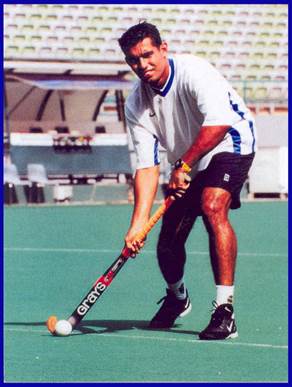
Maninderjit Singh Sidhu of Malaysia
Maninderjit Singh Sidhu was making his second appearance at a World Cup, having played at the Utrecht 1998 World Cup.
He was born in Kuala Lumpur, Malaysia and graduated from University of Malaya. A defender/sweeper, he played for Sapura Hockey Club. He was selected for the Junior squad in January 1990 and played at the Junior World Cup in Tarrasa, Spain in 1993. He earned his first senior cap in November 1992 and played at the Champions Trophy in Kuala Lumpur in 1993. He played at the Asian Games in Hiroshima in 1994 and in Bangkok in 1998. He played at the Commonwealth Games in Kuala Lumpur in 1998 where Malaysia won the Silver medal.
He played at the Atlanta 1996 and Sydney 2000 Olympic Games.
Maninderjit scored a penalty stroke goal at Kuala Lumpur 2002 World Cup.
Malaysia Team: 1. Roslan Jamaluddin (G/K); 2. Maninderjit Singh Sidhu; 3. Boon Huat Chua; 4. Gobinathan Krishanmurthy; 5. Kuhan Shanmuganathan; 6. Nor Azlan Haji Bakar; 7. Chairal Anwar Abd Aziz; 8. Jiwa Mohan; 9. Mohd Madzli Ikmar; 10. Tajol Rosli Mohamed; 11. Mohd Rodhanizam Mat Radzi; 12. Keevan Raj Kali Kavandan; 13. Mirnawan Hj. Nawawi (Capt); 14. Logan Raj Kali Kavandan; 15. Shaiful Azli Abd Rahman; 16. Mohd Nasihin Nubli Ibrahim (G/K); 17. Mohd Fairuz Ramly; 18. Shankar Shanmugam.
Manager: Data Rajaratnam Yogeswaran; Coach: Paul Lissek (Germany).
Final Classification: 1. Germany; 2. Australia; 3. Netherlands; 4. Korea; 5. Pakistan; 6. Argentina; 7. England; 8. Malaysia; 9. New Zealand; 10. India; 11. Spain; 12. Japan; 13. South Africa; 14. Belgium; 15. Poland; 16 Cuba.
Next week: 11th World Cup – Monchengladbach, Germany, 2006.
Sikhs in Hockey

Malaysia’s umpire, Amarjit Singh, in action during the Kuala Lumpur 2002 World Cup.
In our series of the impact Sikhs have had at Men’s Hockey World Cups, we look at the tenth World Cup held in Kuala Lumpur, Malaysia 2002.
The tenth Men’s Hockey World Cup was held at Malaysia National Hockey Stadium, Bukit Jalil, Kuala Lumpur, Malaysia from 24 February - 9 March 2002.
Sixteen nations competed and were divided into two pools of eight as follows:
Pool A: Argentina, Belgium, Germany, Netherlands, New Zealand, Pakistan, South Africa and Spain.
Pool B: Australia, Cuba, England, India, Japan, Korea, Malaysia and Poland.
One Sikh Official, an umpire, was appointed for the Kuala Lumpur World Cup.
Amarjit Singh of Malaysia was on the Umpires panel for his second World Cup, having umpired at the Utrecht 1998 World Cup. He was born in Ipoh, Malaysia and was educated at the Anglo-Chinese School in Ipoh. He graduated from the Open University Malaysia. He was associated with the Perak State Players Association.
He started umpiring at the age of 20 and his first international match was in a 4 Nations tournament in Darwin, Australia when he umpired the Australia v Argentina match in May 1992. He was awarded his International badge in April 1993 and his Grade 1 badge in February 1996. He umpired at the Commonwealth Games in Kuala Lumpur, Malaysia in 1998 and was awarded his World Panel badge in August 1998.
He umpired at the Sydney 2000 Olympic Games.
The Indian team, which was captained by a Sikh, Baljit Singh Dhillon, had seven Sikhs in their squad for Kuala Lumpur 2002 World Cup. This was the exact same setup as in 1975 when the World Cup was played in Kuala Lumpur in 1975 and India won the Gold.

Baljit Singh Dhillon in action
Baljit Singh Dhillon, India’s captain at the Kuala Lumpur 2002 World Cup, was born in Padhr, near Amritsar. He studied at Khalsa College Jalandhar. A forward, he played for Punjab Police and earned his first international cap in 1993 against South Africa. He played at the Champions Trophy in 1995 in Berlin and the Asian Games in 1994 in Hiroshima and in 1998 in Bangkok.
Baljit played at the Atlanta 1996 and Sydney 2000 Olympic Games.
He scored 4 goals at the World Cup in Kuala Lumpur in 2002.
Daljit Singh Dhillon, a forward and younger brother of team captain Baljit, was also making his first appearance at a World Cup. He was born in Jalandhar, Punjab. He played for Punjab Police. He made his international debut in 1998. He played at the Champions Challenge in Kuala Lumpur in December 2001 where India won the Gold.
Daljit, like his elder brother, also scored 4 goals at the Kuala Lumpur 2002 World Cup.
Baljeet Singh Saini, a half back from Punjab was making his second appearance at a World Cup, having played at Utrecht 1998 World Cup. He was born in Ropar, Punjab and played for Punjab & Sindh Bank. He won his first international cap when he was selected for Indra Gandhi Gold Cup in Lucknow in 1995. He captained India’s team at Milton Keynes Junior World Cup in 1997 where India won the Silver medal. He also played at the Asian Games in Bangkok in 1998 where India won the Gold medal.
Baljeet played at the Atlanta 1996 and Sydney 2000 Olympic Games.
Jugraj Singh, a full back and a drag flicker, was making his first appearance at a World Cup. He was born in Rayya, near Amritsar in Punjab. He trained at Surjeet Singh Hockey Academy in Jalandhar and later at Air India Hockey Academy in Delhi. He played at the U18 Asia Cup in Ipoh, Malaysia in 2001 and in the same year played at the Junior World Cup in Hobart and Champions Challenge in Kuala Lumpur.
Jugraj scored three penalty corner goals at the Kuala Lumpur 2002 World Cup.
Kanwalpreet Singh, a fullback from Punjab Police, was making his first appearance at a World Cup. He was born in Jalandhar, Punjab, and played for Punjab Police. He made his international debut in 2000. He played at the Junior Asia Cup in May 2000 and Junior World Cup in Hobart in 2001, which India won. He played in the Champions Challenge in Kuala Lumpur in December 2001 where India won the Gold.
Prabhjot Singh, a forward from Punjab, was also making his first appearance at a World Cup. He was born in Masania in Punjab and studied at Adarsh Vidya Mander in Batala. He played for Indian Oil Corporation. He earned his first international cap in 1999 and played at the Hobart 2001 Junior World Cup where India won the Gold.
Prabhjot scored three goals at the Kuala Lumpur 2002 World Cup.
Sukbir Singh Gill, a mid-field player, was making his first appearance at a World Cup. He was born in Chandigargh, Punjab and graduated from Punjab University in Chandigargh. He played for Bharat Petroleum and won his first international cap at the Azlan Shah Cup in Kuala Lumpur in 1995. He played in the Champions Challenge in Kuala Lumpur in December 2001 where India won the Gold.
Sukbir played at the Sydney 2000 Olympic Games.
Two Sikh brothers were playing in the same team for the fourth time in World Cup history. Baljit and Daljit Singh Dhillon of India were following in the foot-steps of brothers Harvinder and Amarjeet Singh Marwa of Kenya who played in the 1st World Cup in Barcelona in 1971; Harmik and Ajit Singh of India who played at the 2nd World Cup in Amstelveen in 1973 and Hargurnek and Hargurpreet Sandhu of Canada who played at the Lahore 1990 World Cup.
The Dhillon duo Baljit and Daljit scored eight goals at the Kuala Lumpur 2002 World Cup, four a piece.
India Team: 1. Devesh Chauchan (G/K); 2. Ignance Tirkey; 3. Baljit Singh Saini; 4. Prabhjot Singh; 5. Jugraj Singh; 6. Dilip Tirkey; 7. Dhanraj Pillay; 8. Baljit Singh Dhillon (Capt); 9. Jude Menezes (G/K); 10. Sabu Varkey; 11. Sukbir Singh Gill; 12. Lajrus Barla; 13. Arjun Halappa; 14. Deepak Sonkhla Thakur; 15. Bipin Fernandez; 16. Kanwalpreet Singh; 17. Daljit Singh Dhillon; 18. Thirumalvalavan Selvarj.
Manager: KGS Alva; Coach: Cedric D’Souza (1st 4 matches) & C R Kumar.
The Malaysian team had one Sikh in their squad for Kuala Lumpur 2002 World Cup.

Maninderjit Singh Sidhu of Malaysia
Maninderjit Singh Sidhu was making his second appearance at a World Cup, having played at the Utrecht 1998 World Cup.
He was born in Kuala Lumpur, Malaysia and graduated from University of Malaya. A defender/sweeper, he played for Sapura Hockey Club. He was selected for the Junior squad in January 1990 and played at the Junior World Cup in Tarrasa, Spain in 1993. He earned his first senior cap in November 1992 and played at the Champions Trophy in Kuala Lumpur in 1993. He played at the Asian Games in Hiroshima in 1994 and in Bangkok in 1998. He played at the Commonwealth Games in Kuala Lumpur in 1998 where Malaysia won the Silver medal.
He played at the Atlanta 1996 and Sydney 2000 Olympic Games.
Maninderjit scored a penalty stroke goal at Kuala Lumpur 2002 World Cup.
Malaysia Team: 1. Roslan Jamaluddin (G/K); 2. Maninderjit Singh Sidhu; 3. Boon Huat Chua; 4. Gobinathan Krishanmurthy; 5. Kuhan Shanmuganathan; 6. Nor Azlan Haji Bakar; 7. Chairal Anwar Abd Aziz; 8. Jiwa Mohan; 9. Mohd Madzli Ikmar; 10. Tajol Rosli Mohamed; 11. Mohd Rodhanizam Mat Radzi; 12. Keevan Raj Kali Kavandan; 13. Mirnawan Hj. Nawawi (Capt); 14. Logan Raj Kali Kavandan; 15. Shaiful Azli Abd Rahman; 16. Mohd Nasihin Nubli Ibrahim (G/K); 17. Mohd Fairuz Ramly; 18. Shankar Shanmugam.
Manager: Data Rajaratnam Yogeswaran; Coach: Paul Lissek (Germany).
Final Classification: 1. Germany; 2. Australia; 3. Netherlands; 4. Korea; 5. Pakistan; 6. Argentina; 7. England; 8. Malaysia; 9. New Zealand; 10. India; 11. Spain; 12. Japan; 13. South Africa; 14. Belgium; 15. Poland; 16 Cuba.
Next week: 11th World Cup – Monchengladbach, Germany, 2006.
Sikhs in Hockey
Friday, May 16, 2014
At 24, international debut for Jasjit
He has not come through the hard-grind of Academies. He in a way represents amateur-kind of players, who don’t compromise studies for the sake of hockey. Yet, in a short span of taking of up hockey, knocked the doors of Indian team. And makes his international debut not in a run-of-of the mill stuff, but in the mother of all battles, the world cup.
Here you have Punjab’s puttar Jasjit Singh, who is a kind of Viren Rasquinha as he is doing Masters in Business Administration nowadays.
The 24-year old has been included in the Indian team bound for The Hague. Perhaps after Cedric Pereira, now settled in Perth, Australia, a player is making his international debut in a world cup. Cedric was a surprise choice for the first world cup held in Barcelona.
“He trained well, we all felt he can be a good choice”, asserts smiling Roelant Oltmans, who first tested him in the Hockey India League early this year. Jasjit Singh was part of the medal winning team 2014.
“The coach, selection committee are all unanimous of his choice, its unfortunate he had suffered a minor injury before the Europe Tour, and missed it”, elaborates Oltamans.
Jasjit was on the other day had to face the same question from the media at the Holiday Inn where the world cup team was announced, amidst the galaxy of 1975 World Cup goldies. The question was: Don’t you feel the pressure to play your first tournament in World Cup?
The smiling assassin has only one answer: “My coaches say differently. Because I did not play any other tournament, I will be natural, and play my game. This is what I also believe the scene is going to be”
Its not often one come across in India a player making international debut at the age of 24 – considering his colleague in The Hague team Mandeep Singh is six years junior to him, and has already been in the international circuit for well over two years – but Jasjit Singh, who was picked up among the 90-odd probables after the Pune Senior Nationals when Michael Knobbs was at the helm of affairs, could not make any headway further than continue to play for his college team Khalsa in Jalandhar, but his days could not be denied for long.
With a strong midfield where captain Sardar Singh is well anchored, the think tank seemed to have taken a risk of sort in picking up the new face.
It’s a reward for Jasjit, who hardly had any stints in any hard-grind academies, where in fact the academics is the first casualty due to heavy work load, who had only practiced on the Jalandhar Surjit Hockey Academy turfs on Sundays.
“My mother used to take me to the Turf on Sundays because the Academy will have holiday, we can get to play on Turf”.
Jasjit, who joined Indian Railways a couple of years ago, and posted in Jalandhar, relished any position in the midfield, and it gives elbow room for coaches insofar as his utility value is concerned.
Tailpiece: Jasjit is a Kular, a clan which produced n-number of internationals in the 50s and 60s, which included Ajit Pal Singh and Udham Singh, a four-time Olympian. Yes, he is a Sansarpurian.
The squad:
Goalkeepers: P.R. Sreejesh, Harjot Singh.
Defenders: Gurbaj Singh, Rupinderpal Singh (vice-captain), V.R. Raghunath, Birendra Lakra, Kh. Kothajit Singh, Manpreet Singh.
Midfielders: Sardar Singh (captain), S.K. Uthappa, Dharamvir Singh, Jasjit Singh, Chinglensana Singh;
Forwards: S.V. Sunil, Ramandeep Singh, Akashdeep Singh, Nikkin Thimmaiah, Mandeep Singh.
Standbys: Gurpreet Singh (goalkeeper), Vikram Kanth, Gurinder Singh (defenders), Danish Mujtaba, Devindar Walmiki (midfielders), Lalit Upadhyay, and Yuvraj Walmiki (forwards).
Stick2Hockey.com
Here you have Punjab’s puttar Jasjit Singh, who is a kind of Viren Rasquinha as he is doing Masters in Business Administration nowadays.
The 24-year old has been included in the Indian team bound for The Hague. Perhaps after Cedric Pereira, now settled in Perth, Australia, a player is making his international debut in a world cup. Cedric was a surprise choice for the first world cup held in Barcelona.
“He trained well, we all felt he can be a good choice”, asserts smiling Roelant Oltmans, who first tested him in the Hockey India League early this year. Jasjit Singh was part of the medal winning team 2014.
“The coach, selection committee are all unanimous of his choice, its unfortunate he had suffered a minor injury before the Europe Tour, and missed it”, elaborates Oltamans.
Jasjit was on the other day had to face the same question from the media at the Holiday Inn where the world cup team was announced, amidst the galaxy of 1975 World Cup goldies. The question was: Don’t you feel the pressure to play your first tournament in World Cup?
The smiling assassin has only one answer: “My coaches say differently. Because I did not play any other tournament, I will be natural, and play my game. This is what I also believe the scene is going to be”
Its not often one come across in India a player making international debut at the age of 24 – considering his colleague in The Hague team Mandeep Singh is six years junior to him, and has already been in the international circuit for well over two years – but Jasjit Singh, who was picked up among the 90-odd probables after the Pune Senior Nationals when Michael Knobbs was at the helm of affairs, could not make any headway further than continue to play for his college team Khalsa in Jalandhar, but his days could not be denied for long.
With a strong midfield where captain Sardar Singh is well anchored, the think tank seemed to have taken a risk of sort in picking up the new face.
It’s a reward for Jasjit, who hardly had any stints in any hard-grind academies, where in fact the academics is the first casualty due to heavy work load, who had only practiced on the Jalandhar Surjit Hockey Academy turfs on Sundays.
“My mother used to take me to the Turf on Sundays because the Academy will have holiday, we can get to play on Turf”.
Jasjit, who joined Indian Railways a couple of years ago, and posted in Jalandhar, relished any position in the midfield, and it gives elbow room for coaches insofar as his utility value is concerned.
Tailpiece: Jasjit is a Kular, a clan which produced n-number of internationals in the 50s and 60s, which included Ajit Pal Singh and Udham Singh, a four-time Olympian. Yes, he is a Sansarpurian.
The squad:
Goalkeepers: P.R. Sreejesh, Harjot Singh.
Defenders: Gurbaj Singh, Rupinderpal Singh (vice-captain), V.R. Raghunath, Birendra Lakra, Kh. Kothajit Singh, Manpreet Singh.
Midfielders: Sardar Singh (captain), S.K. Uthappa, Dharamvir Singh, Jasjit Singh, Chinglensana Singh;
Forwards: S.V. Sunil, Ramandeep Singh, Akashdeep Singh, Nikkin Thimmaiah, Mandeep Singh.
Standbys: Gurpreet Singh (goalkeeper), Vikram Kanth, Gurinder Singh (defenders), Danish Mujtaba, Devindar Walmiki (midfielders), Lalit Upadhyay, and Yuvraj Walmiki (forwards).
Stick2Hockey.com
Coach almost quits...
THE national hockey squad were within a whisker of heading into the World Cup without a chief coach after an upset K. Dharmaraj decided to quit yesterday.
Angry at being treated as an outcast and irked that repeated requests for a contract fell on deaf ears, Dharmaraj decided enough was enough.
Surviving on a monthly allowance of RM4,000 for the last five months, Dharmaraj skipped the squad’s training session yesterday as he prepared to walk out.
However, word reached Malaysian Hockey Confederation (MHC) president Tengku Abdullah Sultan Ahmad Shah and his quick action resulted in the issue being resolved yesterday evening, just 16 days before Malaysia begin their World Cup campaign.
Even then, MHC didn’t cover itself in glory over the incident, especially as it had no one but Dharmaraj to turn to after Paul Revington quit as national coach.
“I really don’t understand why some of my coaching staff and I were treated like outcasts. Despite repeatedly knocking on the doors of MHC, we never received any feedback on our contracts.
“I did not even know how much my salary scale was for the past five months, and was living on a monthly allowance of RM4,000,” said an upset Dharmaraj after the issue was resolved.
Tengku Abdullah instructed MHC treasurer Datuk N. Radhakrishnan to settle the matter.
“After waiting for five months, I was finally called to the MHC office on Wednesday and asked to sign a contract which only increased my salary by RM2,000 from my juniors contract.
“That was the breaking point, as I was promised many things before this but was then handed a pathetic contract to sign.
“My wife also told me to quit, as I was being treated badly by the very officials who had promised me many things. I also wonder why when the MHC president finally found out about it, it was easily resolved,” said Dharmaraj.
Dharmaraj, based on his achievement in guiding his charges to a fourth-placed finish in last year’s Junior World Cup, is in the running for Coach of the Year at Monday’s national sports awards.
He has proven his mettle with the senior side as well for after having replaced Revington, he guided the team to a silver-medal finish behind Australia in the Azlan Shah Cup.
That was followed by a bronze medal finish in the Champions Challenge 1 in Kuantan.
“The issue here was not about money but I was peeved with the way they handled my case as I kept knocking and knocking my head against the MHC door, with no answer.”
Malaysia are in Group A of the World Cup with Australia, England, Belgium, Spain and India.
Subscribe to:
Posts (Atom)


The national players undergo a training session at the National Hockey
Stadium in Bukit Jalil on Tuesday in preparation for the World Cup. Pic
by Hasriyasyah Sabudin